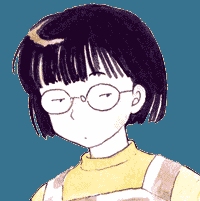


What does "bori bori" mean, anyway? Let's ask...
Gerard Jones, Rewriter to the Stars!
To tell the truth, I'd never heard of Rumiko Takahashi until Viz Comics gave me the opportunity to do the rewriting on Lum * Urusei Yatsura. I had quite an interest in Japanese culture, and had even learned some Japanese, but I'd never paid much attention to manga or anime. The few Japanese comics I'd glanced at had left on a vague impression of interminable fight scenes and silent reaction shots. My first entry into the world of Urusei was a revelation- this dense, funny, character-rich, pun-heavy tale of adolescent lust and stupidity was unlike anything I'd ever seen anywhere. It was also a rewriter's nightmare.This "rewriting" or "co-translating" consists of turning a too-literal translation of the Japanese text into English that's supposed to be clear, brisk and funny to American comic readers. [1] That includes turning mystifying sound effects like "bori bori" into sounds more evocative to our ears, like "clomp clomp". It includes trying to convey the nuances of Japanese regional dialects and myriad levels of verbal formality into American equivalents. Worst of all, it includes making up new jokes that accomplish the purpose of Takahashi's untranslatable originals.
From the first issue of Urusei Yatsura, I was hammered by intercultural brainbusters. Like the monk whose name is the English word "Cherry" because the Japanese characters meaning "confused monk" can be mispronounced to sound like the Japanese word for "cherry". Or the kid throwing beans at the alien because the alien looks like a Japanese folkloric demon, who can be kept out of one's house by the stewing of the beans. I did the best I could- in my rewrite, the monk calls himself Cherry in honor of his monastic life, which looks soft and sweet outside, "but when you get into it, it's the pits"; the kid yells "Here, candy!" to show that he's hoping the alien is just an overage trick-or-treater.
The manga purists don't seem to like such tricks. I guess they'd rather read the literal translation and smile to themselves in the knowledge that they're among the blessed few who know all the cultural references. I took it as my job to make Takahashi's dazzling characters and stories as accessible as possible to new readers. Her ferocious energy and acute comic eye were revelations to me. I wanted others to be able to have the same revelation I did.
Once or twice I just had to throw up my hands and surrender. In Maris the Chojo (formerly The Supergal), recently printed in this magazine, the then-inexperienced Takahashi had her pompous characters suddenly and inexplicably slip into the Kansai dialect of western Japan as the story neared its climax. I thought of rewriting those lines in a caricatured Deep South accent, since Kansai is sneered at by up-country sophisticates as a sort of "hick-speak." But somehow it just didn't... well, translate. Some cultural baggage, some sense of the inherent humor in the juxtaposition of Kansai and Kanto dialects, just didn't make it into an American context. I contented myself with having them speak increasingly informally as their grand schemes and melodramatic posturings fell apart. So the evil kidnapper shifted from "I'll kill her so cruelly, the entire space patrol will shudder" to "What am I supposed to do now that my hideout's all smashed." Takahashi's absured switch might have tickled the clever Tokyo middle-school students, but I could just see my American readers scratching their heads over the sudden intrusion of "Whut am I s'posed to do now thet muh hideout's all smay-ashed." I hope the mangaphiles can forgive.
Fortunately for me, as Takahashi's work has matured, she's depended less and less on word games and more and more on what was always her greatest strength- character. Cherry the monk became far funnier when he dropped the triple-layer puns and just drove everyone crazy with his pessimism, his startling entrances and his bottomless-pit appetite. There's hardly a single pun in Ranma 1/2, the bizarre martial-arts sex comedy of the mature Takahashi, which Viz is currently publishing. There are only vivid characters, raging emotions, suspenseful plots and hilarious twists.
It makes for better comics. And it makes for a much happier rewriter. Now all I have to do is keep the characters talking like themselves, keep the lines as pointed as I can... and figure out what occidental sound effect could possibly capture all the nuances of "zawa zawa zawa." [2]
Footnotes
- [1] Gerard Jones was in charge of the "English adaptation" of nearly all of Rumiko Takahashi's works into English from Urusei Yatsura, Maison Ikkoku, Ranma 1/2 and Inuyasha. By the time of Kyokai no RINNE, Viz had essentially ceased having someone handle "adaptation" in addition to translating as they were moving to a quicker release schedule. Most of Jones' work on Takahashi's English releases is no longer available as Viz has had fresh translations done of all of the projects Jones worked on. Though this has never been commented on by Viz, it is likely due to Gerard Jones being arrested and sent to prison.
- [2] "Zawa zawa zawa" is a murmuring sound effect used in manga. It has come to be associated Nobuyuki Fujimoto's Gambling Apocalypse Kaiji (賭博黙示録カイジ/Tobaku Mokushiroku Kaiji).

Animerica Vol 1, No. 2
|